Water-based topcoats now cover much of the architectural market, but solvent-based finishes still lead in several exposures, and the right choice starts with the project rather than the label.
For architects, specifiers and facility owners, choosing between a water-based and a solvent-based topcoat affects appearance, maintenance cycles and whether the project complies with local air rules. Water-based technology is now a credible choice for many architectural surfaces, but it is not a direct substitute for every solvent-based system.
This article covers how the two technologies differ, how VOC regulations shape the choice, where each one performs best and how jobsite conditions change the answer.
What Is the Difference Between Water-Based and Solvent-Based Coatings?
The terms describe the carrier, the liquid that keeps the coating fluid until it is applied. They do not describe the binder. Acrylics, epoxies and polyurethane-type chemistries are available in both carrier types, so a fair comparison is between two specific products of similar generic type.
Film formation is the practical difference. Many water-based finishes are dispersions, in which small polymer particles fuse into a continuous film as water and a small amount of coalescing solvent leave. Many solvent-based high-performance finishes are two-component products that cure by chemical crosslinking.
Water-based two-component products also exist, and they narrow the gap considerably. Water-based also does not automatically mean zero VOC, because many products contain co-solvents. The number to compare is the VOC content on the product data sheet, determined by the EPA Method 24 test procedure.
VOC Regulations: The Floor, Not the Deciding Factor
At the federal level, the EPA National Volatile Organic Compound Emission Standards for Architectural Coatings (40 CFR Part 59, Subpart D, finalized in 1998) limit VOC content by coating category. The rule is directed at manufacturers and importers, so compliant products reach the market already labeled for their category.
States and air districts can be stricter. Many Northeast and Mid-Atlantic states have adopted architectural and industrial maintenance coating rules based on Ozone Transport Commission model rules. The architectural coatings rule of the South Coast Air Quality Management District (Rule 1113) is among the most restrictive, and its published Table of Standards lists 100 grams per liter for the Industrial Maintenance category.
Two points follow for specifiers:
- Compliance Is Local: Compliance is decided by project location and coating category, so the specification should require the contractor to confirm that every product complies in that jurisdiction.
- Lower Limits Do Not Dictate the Carrier: High-solids solvent-based coatings comply in many jurisdictions, so the exposure still drives the selection.
Water-Based Performance: Where the Gap Has Closed
For architectural concrete, masonry, stucco, drywall and light-duty steel, quality water-based acrylics are a mainstream choice. Pure acrylic binders resist ultraviolet degradation well, stay flexible and allow vapor to pass, which suits substrates that move moisture.
Newer water-based composite and hybrid finishes are described by their manufacturers as approaching solvent-type color and gloss retention on structural steel. Specifiers comparing candidates should ask for weathering data generated under the same method and duration, such as fluorescent UV-condensation exposure (ASTM D4587), and compare gloss and color change side by side.
The HPC articles on fluoropolymers and polyurethanes and on QUV exposure testing cover that evaluation in more detail:
Solvent-Based Finishes: Where They Still Lead
Solvent-based technology remains the common choice in several situations, based on general industry practice:
- Severe Exposure: Chemical fumes, frequent wetting, standing water or situational immersion.
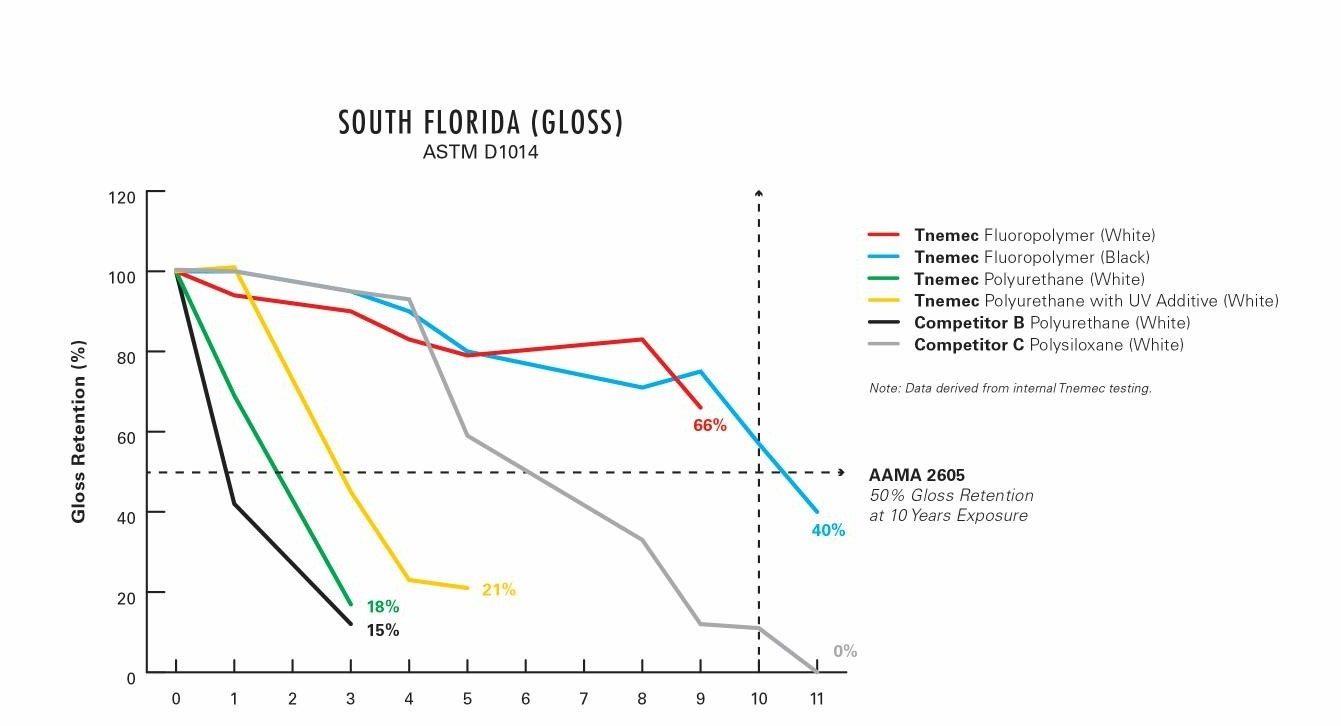
- Maximum Appearance Retention: Projects where the longest color and gloss retention is the priority, which is where solution fluoropolymer finishes are typically specified.
- Film Build per Pass: High-build single-coat application over large steel areas.
- Difficult Seasons: Cool, damp application windows where a water-based film may not coalesce or cure properly.
Application Windows: How Jobsite Conditions Change the Answer
Water-based finishes depend on evaporation. Low temperatures and high humidity slow the release of water, which can cause poor film formation, surfactant leaching (a sticky or streaked residue) or wash-off if rain arrives before the film sets.
Bare steel can flash rust under some water-based primers if conditions are not controlled. In return, water-based products offer low odor and water cleanup, and they are generally easier to apply in occupied schools, hospitals and offices.
Solvent-based products generally tolerate a wider range of cool or humid conditions and often reach rain resistance sooner. They bring stronger odor, flammability concerns and ventilation requirements, and many two-component aliphatic polyurethanes contain isocyanates that require appropriate respiratory protection.
Compatibility with the existing coating matters for both technologies. A new finish over an aged coating can lift or wrinkle the old film, so test patches are recommended before full application. The HPC article Overcoating Versus Complete Removal: Making the Right Choice explains how adhesion and condition testing guide that decision.
Choosing a Topcoat: Water-Based or Solvent-Based
The following paired criteria summarize the typical fit for each technology.
Choose Water-Based When
- Exposure: The service is architectural or light-duty industrial rather than chemical or immersion.
- Occupancy: The building will be occupied during the work, or odor and flammability are a concern.
- Weather: The application window offers moderate temperatures and humidity.
- Substrate: The surface is concrete, masonry or stucco that benefits from a breathable film.
Choose Solvent-Based When
- Exposure: The steel faces chemical fumes, frequent wetting or coastal conditions.
- Appearance: Maximum long-term color and gloss retention is the owner's priority.
- Schedule: The work must proceed in cooler or damper weather.
- Compliance: The project's VOC rules allow it and a compliant product with the needed performance is available.
Tnemec Options: Water-Based and Fluoropolymer Finishes
Tnemec Company offers both technologies. Tnemec Series 1028 Enduratone and Tnemec Series 1029 Enduratone are water-based, low-VOC high dispersion pure acrylic polymer coatings for interior and exterior exposures. Tnemec Series 1061 Oculox is a water-based, two-component silicon-grafted composite topcoat for structural steel, tank exteriors and decorative metals. Tnemec Series 156 Enviro-Crete is a modified waterborne acrylate for concrete and masonry.
Where maximum color and gloss retention is the goal, Tnemec Series 1071V Fluoronar is a low-VOC advanced thermoset solution fluoropolymer finish.
Conclusion
Choosing a topcoat is not a vote for or against a technology. We recommend starting with the exposure and the owner's appearance expectations, confirming the VOC rules for the project location, and then comparing specific products of similar generic type on test data and application requirements.
Water-based finishes now serve much of the architectural market well, and solvent-based finishes remain the right tool where severe exposure, long-term appearance or difficult weather call for them. The carrier matters less than the match between the product and the job.
Field Verification Before Specifying
The following conditions are to be confirmed in the field with the applicable test before a system is finalized:
- Ambient temperature, surface temperature, relative humidity and dew point at time of application, checked against the product data sheet (ASTM E337 psychrometer or electronic gauge).
- Existing coating type, condition and adhesion before overcoating (ASTM D3359 or ASTM D4541) and a test patch.
- Existing coatings for hazardous materials such as lead, by laboratory analysis.
- Concrete or masonry moisture before coating (ASTM D4263 plastic sheet method, or as required by the product data sheet).
- Dry film thickness of the installed system (SSPC-PA 2 with ASTM D7091 gauges on steel).
- VOC compliance of each specified product for the project jurisdiction and coating category (product data sheet and local air district rule).
We are happy to help. Contact a High Performance Coating Consultant in your region to review your project conditions and specification.